
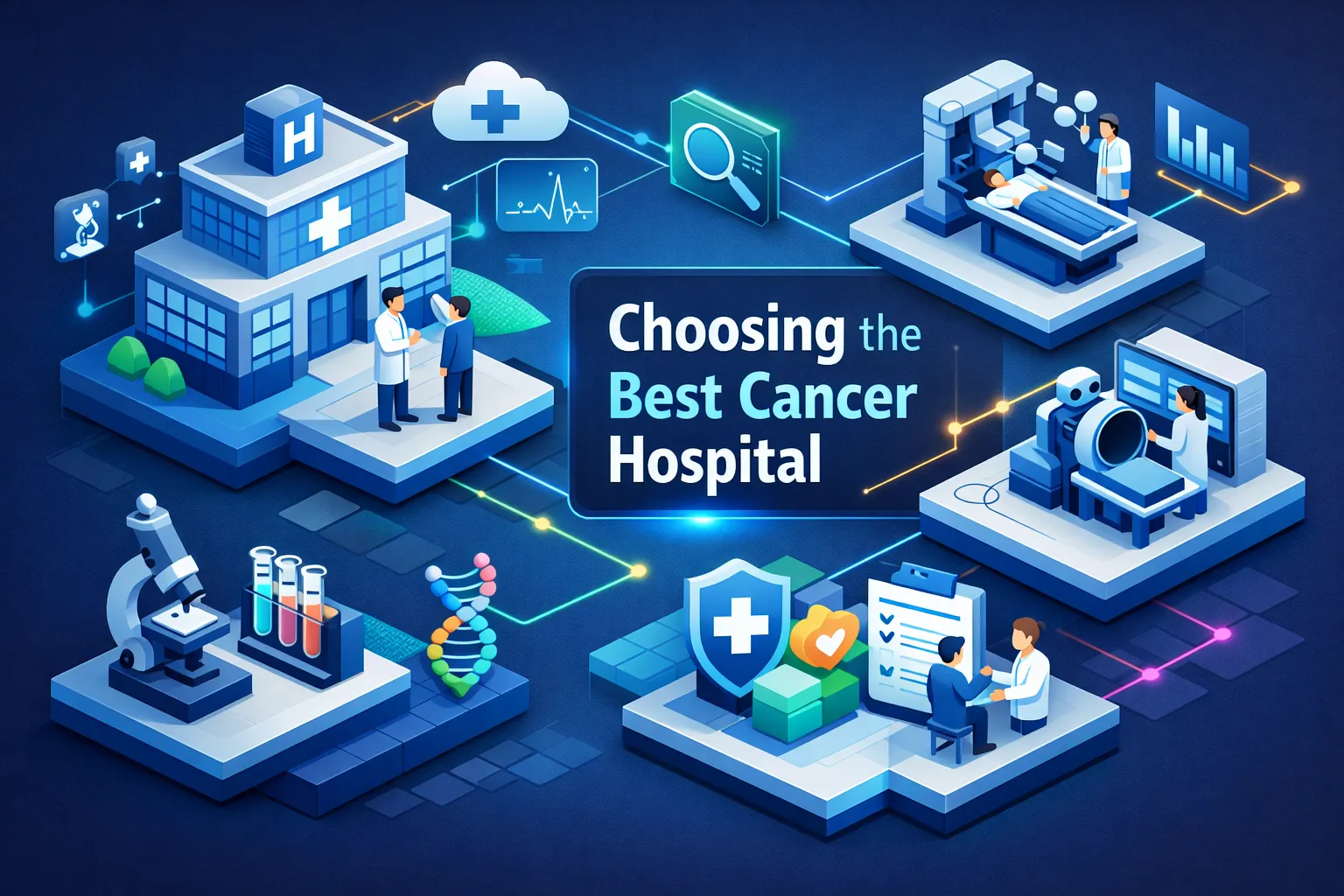
 A cancer diagnosis leaves families with almost no time and forces one of the most consequential decisions they will ever make: which hospital do you trust with someone’s life? For patients in Hyderabad and NRI families coordinating care from the United States, the options among cancer hospitals in Hyderabad are numerous, but quality is uneven. The right choice depends on far more than proximity or reputation alone.
This guide walks you through exactly how to evaluate an oncology hospital on the dimensions that actually affect outcomes: specialty depth, doctor credentials, diagnostic infrastructure, accreditations, and cost. We will also cover the specific questions to ask before booking a consultation, and how families based in the US can coordinate care efficiently from abroad. Asvins Specialty Hospitals, led by one of Hyderabad’s most experienced surgical oncologists with 40+ years of practice, serves as a reference point throughout because its focused cancer care model illustrates what purposeful oncology infrastructure looks like in practice.
What separates a specialty cancer hospital from a general hospital’s oncology unit
The distinction matters more than most families realize. A dedicated cancer hospital builds every system around oncology: tumor-specific ICUs, cancer subspecialty teams who treat nothing else, and operating theaters scheduled around oncological timelines. A general hospital’s oncology wing, by contrast, shares resources with orthopedics, cardiology, and emergency care. That competition for time, equipment, and staff directly affects how quickly and how well a cancer patient gets treated.
A cancer specialty hospital is designed so that a surgical oncologist, a medical oncologist, and a radiation oncologist can sit in the same room and discuss one patient’s case before treatment begins. That coordination is not a courtesy feature. It changes treatment decisions, prevents contradictory advice, and shortens the time between diagnosis and action.
The multidisciplinary tumor board: what it is and why it matters
A multidisciplinary tumor board is a structured, scheduled meeting where specialists across surgical, medical, and radiation oncology review each complex case together before finalizing a treatment plan. A systematic review published in the Journal of Clinical Oncology links tumor board review to longer disease control, higher survival rates, and reduced recurrence risk compared to solo oncologist decision-making. In a neuro-oncology study at Johns Hopkins, 59% of cases had changes in clinical management after tumor board review. (See a primer on the team approach to cancer care for more context.)
Asvins Specialty Hospitals operates under this model. Decades of surgical oncology experience are integrated with medical and radiation oncology disciplines under one roof. Patients receive one unified, coordinated plan rather than fragmented advice from siloed departments. For a family making decisions across time zones, that coordination is both clinically stronger and logistically simpler.
Choosing a cancer hospital in Hyderabad: key oncology specialties
Every credible cancer centre must offer three foundational disciplines: surgical oncology for tumor removal and resection, medical oncology for chemotherapy and immunotherapy, and radiation oncology including techniques like IMRT, IGRT, and SBRT. A hospital missing any one of these cannot deliver complete cancer care in-house, which means patients will be referred outward at critical moments in their treatment.
Subspecialties matter just as much. Gynecological oncology, thoracic oncology covering lung and mediastinal tumors, and breast oncology each require surgeons trained specifically in those anatomical sites and cancer types. A general surgical oncologist is not a substitute for a subspecialist when the diagnosis is complex or the case requires precision beyond standard resection.
Matching the hospital’s specialty strengths to your cancer type
A hospital’s reputation in one area does not automatically translate to strength across all cancers. Families should ask whether the hospital has a dedicated subspecialty team for their specific cancer type, not just a general oncology department that handles everything. The answer tells you whether the team treating your family member performs these procedures regularly or only occasionally.
Asvins Specialty Hospitals states that its subspecialty coverage includes gynecological oncology, thoracic oncology, and comprehensive breast surgery encompassing biopsy, surgery, chemotherapy, and hormonal treatment. Chemotherapy and targeted therapy using cytotoxic drugs, immune modulators, and targeted agents are also available on-site. According to the hospital, patients with these diagnoses are typically managed without requiring transfer elsewhere for subspecialty care.
Supporting specialties that matter more than families realise
Cancer treatment frequently triggers secondary complications that demand immediate attention. Chemotherapy puts significant stress on the kidneys. Abdominal surgeries can cause digestive complications. Certain cancers involve bone metastases that require orthopedic management. When any of these complications arise, a transfer to another hospital adds hours of delay, new admission paperwork, and a clinical team that has never seen the patient before. A hospital with integrated
nephrology, gastroenterology, and orthopedic services manages these situations in the same facility, keeping care continuous and the clinical team fully informed.
How to evaluate a doctor’s credentials and cancer expertise
Years of experience matter, but the type of experience matters more. A surgical oncologist who has performed thousands of cancer resections across breast, gastrointestinal, thoracic, and gynecological sites develops a level of pattern recognition that a generalist cannot replicate. When evaluating any oncologist in Hyderabad, look specifically for subspecialty fellowship training, surgical case volume in the relevant cancer type, and whether the doctor participates in academic publishing or teaching.
Hyderabad has a genuinely strong pool of senior oncologists. Dr. Ramesh Parimi at PACE Hospitals brings 38+ years in surgical oncology with over 20,000 procedures across breast, gastric, gynecologic, and thoracic cancers. Dr. Y. Nalini at Yashoda Hospitals has 32 years in radiation oncology. Among the senior surgical oncologists in the city is Dr. G. Suryanarayana Raju of Asvins Specialty Hospitals, with over 40 years of surgical oncology experience, a benchmark for what depth of practice looks like within Hyderabad’s oncology community.
How to verify credentials before the consultation
For NRI families coordinating from the US, credential verification is entirely possible before committing to travel or surgery dates. Check that the doctor is registered with the National Medical Commission (NMC), which replaced the Medical Council of India in 2020, and confirm registration with the appropriate State Medical Council. Ask the hospital directly for the doctor’s subspecialty training background and approximate annual case volume for the specific cancer type. Then request a teleconsultation before making any decisions about dates, flights, or surgical scheduling.
The teleconsultation step is non-negotiable. It lets you assess how clearly the oncologist explains the diagnosis, whether the treatment plan makes sense given the pathology reports you already have, and whether you feel confident in the clinical judgment being offered. A hospital that resists this step or routes you only to administrative staff is a signal worth heeding.
Accreditations, technology, and on-site facilities at oncology hospitals in Hyderabad
NABH accreditation confirms that a hospital meets India’s national quality and safety standards: patient care protocols, infection control, medication management, and facility safety. JCI accreditation reflects international benchmarking against global standards. Both are worth verifying before shortlisting any hospital. That said, treat accreditation as a floor, not a ceiling. It tells you about process compliance, not about clinical outcomes or surgical expertise.
Among the oncology hospitals in Hyderabad, Renova Hospitals, Omega Hospitals, Basavatarakam Indo American Cancer Hospital, and KIMS Secunderabad hold NABH accreditation. Continental Hospital holds JCI accreditation. Verify current accreditation status directly with the NABH or JCI registries, as certificates are renewed on a cycle and status can change. Use these as baseline filters when narrowing your shortlist, then look beyond the certificate to evaluate the clinical team and the specific technology available for your cancer type.
Diagnostic technology and on-site support that reduce treatment delays
On-site diagnostics are a clinical safety requirement during active cancer treatment. When a patient is mid-chemotherapy and develops a complication, the ability to run a CT scan, blood panel, or ultrasound within the same building within hours rather than days can change the outcome entirely. Outsourcing diagnostics to external centres introduces delays that are unacceptable during active oncology care.
Asvins Specialty Hospitals reports maintaining on-site CT scan, X-ray, ultrasound, colposcopy, and 24/7 laboratory services, along with a 24/7 pharmacy, ICU, and ambulance service. For a patient undergoing chemotherapy, recovering from major cancer surgery, or managing a post-operative complication, this kind of integrated infrastructure keeps the entire care team informed and responsive in real time.
Cancer treatment costs in Hyderabad: what families should expect
Cost decisions carry their own emotional weight, especially for families already stretched thin by a diagnosis. Understanding what to expect financially does not make the decisions easier, but it does make them clearer. Chemotherapy per cycle in Hyderabad ranges from approximately ₹10,000 to ₹1,50,000 depending on the drug regimen, with targeted therapy and immunotherapy protocols sitting at the higher end of that range. A full multi-cycle course typically totals between ₹2.5 lakhs and ₹25 lakhs depending on the cancer type and protocol. For reference on national figures, see this summary of chemotherapy cost in India per cycle. Radiation therapy using IMRT or IGRT at private hospitals in Hyderabad runs approximately ₹2,00,000 to ₹3,50,000 for a full course of 20 to 30 sessions.
Cancer surgery costs vary considerably with complexity. Straightforward procedures at lower-cost centres start around ₹75,000. Complex resections at major private hospitals can reach ₹10,00,000 or more, depending on the surgical site, reconstruction requirements, and length of hospital stay. Always request a written estimate covering surgery, anaesthesia, the hospital stay, and post-operative care before agreeing to a date.
How Hyderabad costs compare for NRI families evaluating India vs. the US
For NRI families navigating US oncology billing, Hyderabad offers the full range of cancer treatments at a substantially lower cost. Based on publicly available cost data, chemotherapy regimens that run $15,000 to $30,000 per cycle in the United States can often be completed in Hyderabad at a fraction of that figure, typically estimated at 10 to 15 percent, without sacrificing access to targeted therapy, immunotherapy, or surgical expertise, though actual savings vary by regimen and facility. The same pattern applies to radiation therapy: full IMRT courses that cost $30,000 to $50,000 in the US are available at significantly lower rates at top private hospitals in Hyderabad.
Request a written, itemized estimate that covers every component: surgery, anaesthesia, hospital stay, medications, post-operative consultations, and any follow-up scans. Ask what happens if complications extend the hospital stay. A hospital that provides this information clearly is one that respects the family’s need to plan, especially when that family is managing logistics from overseas.
Six questions to ask before shortlisting any cancer hospital in Hyderabad
Before committing to any cancer hospital in Hyderabad, families should get specific answers to specific questions. Vague reassurances are not enough. Ask questions that require the hospital to provide verifiable, concrete information about clinical process and team structure.
- Does the hospital have a dedicated tumor board that will review my specific case?
Ask when it meets, who attends, and whether your case will be presented before treatment planning begins.
- How many procedures of this type has the lead surgeon performed in the last year?
Annual volume for the specific cancer type matters more than career totals in some instances.
- Are medical oncology, surgical oncology, and radiation oncology all available on-site, or through referral?
Referral arrangements introduce delays and coordination gaps during active treatment.
- What accreditations does the hospital hold, and when were they last renewed?
NABH certificates are renewed on a cycle; confirm current status directly with the NABH registry.
- Can we arrange a teleconsultation with the treating oncologist before travelling to Hyderabad?
Insist that the consultation includes the surgeon or specialist, not just a patient coordinator.
- What is the estimated all-inclusive cost, and what is specifically covered in that figure?
Ask for this in writing and clarify what happens if complications extend the hospital stay.
For guidance on what to ask your surgeon specifically during preoperative planning, this set of questions to ask your surgeon can help structure that conversation and ensure you cover essential topics.
How NRI families can coordinate cancer care from the United States
Most credible cancer hospitals in Hyderabad now offer teleconsultation services that allow families in the
US to speak directly with the treating oncologist, review diagnostic reports digitally, and receive a clinical second opinion before finalizing travel arrangements. The process typically involves scheduling through the hospital’s telemedicine portal, completing payment to confirm the appointment, and sharing all existing imaging, pathology, and lab reports in advance. Request that the meeting include the surgeon or oncologist directly, not just administrative staff.
For families coordinating care through Asvins Specialty Hospitals, the multidisciplinary structure means a single coordinated conversation can address surgical planning, chemotherapy protocols, supportive care questions, and logistics together. This matters enormously when the family member managing the process is doing so across a 10- to 12-hour time difference with limited availability during Indian business hours.
Making the right decision starts with the right framework
Choosing the right cancer hospital in Hyderabad comes down to five factors evaluated together: specialty depth that matches the specific diagnosis, credentialed senior oncologists with subspecialty training in the relevant cancer type, on-site diagnostic and support infrastructure that eliminates dangerous delays, relevant accreditations as a baseline quality filter, and transparent cost estimates that allow families to plan with confidence. No single factor is sufficient on its own. A hospital with impressive technology but a generalist surgical team is not the right choice for a complex gynecological oncology case. A highly credentialed surgeon at a facility with limited on-site diagnostics creates a different set of risks.
For patients and NRI families looking for a starting point backed by deep surgical oncology experience, Asvins Specialty Hospitals offers 40+ years of practice under one of Hyderabad’s most experienced cancer surgeons, a full-spectrum oncology model covering surgical, medical, and supportive disciplines, and integrated multi-specialty support including nephrology, gastroenterology, and orthopedics, all under one roof. The hospital’s stated 24/7 diagnostic services, ICU, and pharmacy are designed to ensure that care continues when complications arise outside normal hours.
To discuss your specific case, book a teleconsultation with the Asvins team from the US or schedule an in-person visit if you are in Hyderabad. Bring your existing reports, imaging, and pathology results. The goal of that first conversation is a clear, honest picture of what treatment looks like, what it costs, and what comes next.
