
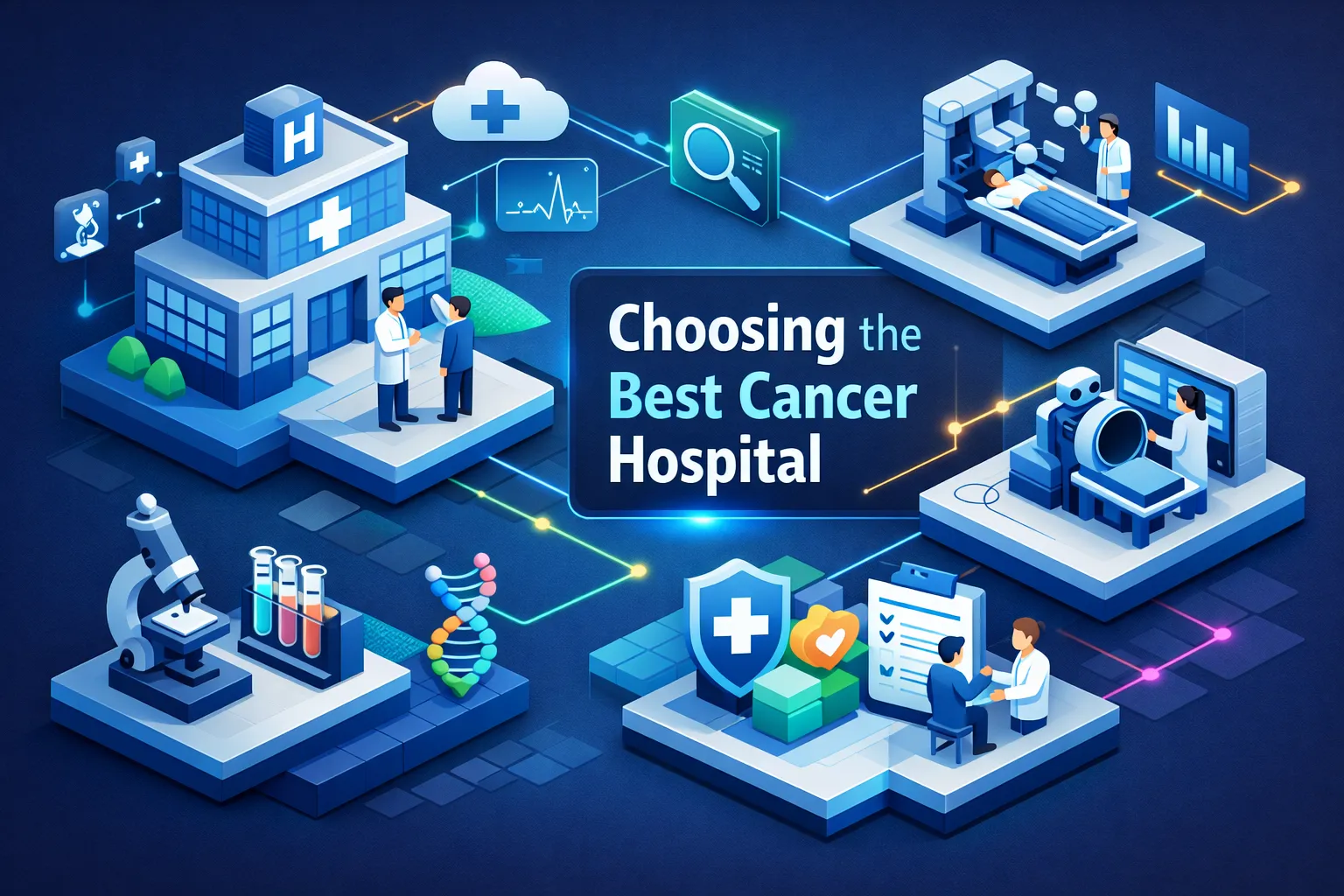
 Best Cancer Hospital: What Every Patient Should Know Before Choosing
Choosing the best cancer hospital is the first critical decision after a diagnosis, and it may also be the most consequential. Patients and caregivers suddenly find themselves comparing dozens of facilities, each claiming to offer exceptional cancer care, with no clear framework to tell them apart.
The difference between average and excellent cancer care is measurable. It shows up in surgical complication rates, treatment completion numbers, tumor board structure, and five-year survival data. These aren’t subjective impressions; they’re benchmarks that leading oncology centres worldwide are held to, and that patients can use to evaluate any hospital before committing. Facilities like Asvins Specialty Hospitals in Hyderabad show that high-quality, structured cancer care is available in India without the cost or logistical burden of traveling abroad.
By the end of this article, you’ll have a concrete checklist, a shortlist strategy, and a clear picture of what separates a genuinely capable cancer treatment hospital from one that just markets itself well.
The benchmarks that define the best cancer hospitals worldwide
Surgical oncology expertise and specialization
A dedicated surgical oncology team tends to deliver meaningfully better results than a general surgery department across outcomes including margin clearance and post-operative complication rates. The reason is straightforward: cancer surgery is not a subset of general surgery. It requires subspecialty depth in areas like breast oncology, gynecological cancers, thoracic tumors, and musculoskeletal oncology, and that depth only develops through years of focused case volume.
When evaluating any hospital, ask specifically about years of specialist experience, annual case volume for your cancer type, and whether the surgical team operates across subspecialties or routes everything through a generalist. High-volume surgical oncology programs are associated with lower complication rates and better margin clearance, both of which directly affect recurrence risk.
Multidisciplinary tumor board approach
A tumor board brings surgical, medical, and radiation oncologists together to review each case before a treatment plan is finalized. This isn’t a formality; it’s one of the most evidence-backed structures in oncology. A meta-analysis of tumor board studies found substantially improved survival and management
outcomes for patients reviewed by multidisciplinary teams. A meta-analysis of 59 studies involving over 134,000 cancer patients found that tumor board patients had a median overall survival of 30.2 months compared to 19 months for those managed without board review. At five years, 56% of tumor board patients were alive versus 45% of controls.
Beyond survival data, research shows that tumor board review changes clinical management in 2 to 52% of cases. A neuro-oncology program at Johns Hopkins found that 59% of patients had changes in their management plan after multidisciplinary board review. In practice, tumor boards have been shown to prolong cancer patient survival, making a formal board a non-negotiable feature of quality care. Any cancer hospital that does not operate a formal tumor board is a significant red flag. Ask directly whether your case will be presented to one before treatment begins.
On-site diagnostics and treatment technology
How quickly treatment begins after diagnosis depends heavily on whether a hospital has its diagnostics in-house or outsourced. CT scans, ultrasound, colposcopy, and around-the-clock lab services available within the facility eliminate delays that come with external referrals. For complex cases, every day matters.
Advanced radiation options like IMRT and image-guided radiation therapy, alongside targeted therapy protocols, signal a hospital’s clinical depth. Ask specifically what is available on-site versus what requires an outside referral. Any cancer care centre that requires patients to outsource major diagnostic steps is not a fully integrated oncology facility.
Why patient outcomes are the real measure of any cancer centre
How to read survival rates and success metrics
Rankings and award logos are easy to manufacture. Outcomes data is considerably harder to fake. Five- year survival rates are the standard metric, but they require context to be useful. A hospital quoting broad, facility-wide survival statistics is giving you marketing data. What you need are disease-specific, stage- matched outcomes for your cancer type.
Published data from Tata Memorial Hospital on oral cancer illustrates why stage matters: five-year survival ranged from 83% at Stage I to 55% at Stage IV. That’s not a small difference. Asking for stage- specific survival data for your diagnosis gives you a far more honest picture of what a hospital actually delivers than any general ranking. Recent reports on five-year breast cancer survival rates in India also highlight the importance of regional and stage-specific context when interpreting survival numbers.
Treatment completion rates and follow-up care
Published Tata Memorial data highlights another critical variable: patients who completed their full treatment course achieved a 67% survival rate compared to 43% for those who received only partial treatment. A hospital’s ability to support patients through the full treatment journey, clinically, logistically, and financially, directly affects the outcomes it can claim.
Ask whether the hospital has structured follow-up protocols after surgery or chemotherapy. A facility that provides excellent surgery but hands patients off without a defined follow-up plan is delivering incomplete care. The best hospitals for cancer treatment address the full arc of the disease, not just the acute phase.
How to choose the best cancer hospital: understanding the cost gap
India vs. US cancer treatment cost comparison
For NRI families and medical travellers, cost is a legitimate medical decision factor, not a compromise. The numbers make this clear. Cancer surgery at top Indian hospitals typically runs between ₹1,00,000 and
₹5,00,000; comparable procedures in the US cost USD 30,000 to 100,000 or more, based on published hospital pricing data and international cost-comparison analyses. Chemotherapy per cycle in India ranges from ₹10,000 to ₹2,00,000 depending on the regimen; in the US, a single cycle can exceed USD 10,000.
Based on current private hospital pricing, a complete breast cancer treatment package in India, including surgery, chemotherapy, and radiation, runs approximately USD 12,000 to 28,000. The US equivalent for the same package regularly exceeds USD 100,000. Bone marrow transplants in India range from ₹15 to 48 lakh; in the US, the same procedure frequently exceeds USD 300,000. These are not marginal differences; they represent life-changing financial consequences for most families. If you need a quick reference for reputable facilities, consult a curated list of top cancer hospitals in India when building your shortlist.
What affordability should and shouldn’t mean
Cost-effective cancer treatment in India does not mean reduced clinical quality. Lower costs reflect structural differences, overhead, labour, and regulatory expenses, rather than clinical shortcuts. Indian hospitals holding NABH accreditation are evaluated against internationally comparable benchmarks, similar in rigour to those used by the Joint Commission in the United States. NABH is recognized by ISQua (the International Society for Quality in Health Care), which assesses accreditation programs against global standards.
The right approach is to evaluate cost alongside accreditation, outcomes, and surgeon credentials rather than as a standalone factor. Always request an all-inclusive treatment estimate that covers diagnostics, pharmacy, ICU stays, and follow-up consultations. Surprise costs from these line items can add 20 to 50%
to initial quotes at hospitals that don’t offer transparent packages.
How to evaluate any cancer hospital before you commit
Questions to ask the oncology team before deciding
A hospital’s responsiveness to direct questions tells you as much as its brochure. Before committing to any facility, ask the following and pay close attention to the clarity and speed of the answers.
How many cases of this specific cancer type does your team manage per year?
Is there a multidisciplinary tumor board that will review my case before treatment begins? What is your policy on second opinions, and will you facilitate one if requested?
Is the full treatment managed within this facility, or will I need to go elsewhere for specific steps?
What does a complete treatment package cost, including diagnostics, chemotherapy, surgery, and follow-up?
A hospital that answers these questions clearly and promptly is demonstrating the communication standard you’ll need throughout treatment. Vague responses or delayed replies are not administrative delays; they’re clinical signals.
Accreditations, credentials, and red flags
NABH accreditation signals compliance with Indian quality standards, evaluated across 500 to 600 measurable objectives covering patient care, infection control, medication management, and facility safety. JCI accreditation signals alignment with global benchmarks. Both require extensive on-site inspection and periodic reaccreditation.
For surgical oncologists, look for an MCh or DNB in Surgical Oncology, membership in the Indian Association of Surgical Oncology, and ideally 15 or more years of subspecialty experience, not general surgical experience, for senior surgeons. Red flags include vague cost estimates, no tumor board, outsourced diagnostics, no dedicated oncology ward, and surgeons without subspecialty oncology qualifications.
How Asvins Specialty Hospitals meets these global cancer care standards
Surgical expertise and specialty depth in one facility
Dr. G. Suryanarayana Raju leads surgical oncology at Asvins Specialty Hospitals, bringing extensive dedicated subspecialty experience across breast oncology, gynecological cancers, thoracic tumors, and
musculoskeletal oncology. The program operates under one roof, this is not a generalist surgery department handling occasional cancer cases, but a focused oncology program built on concentrated, long-term case volume.
High case volume means the surgical team at Asvins approaches complex cancer presentations with familiarity rather than novelty. For patients and families comparing cancer treatment hospitals in Hyderabad, this depth of subspecialty experience is a concrete differentiator worth asking about directly.
Multidisciplinary care, diagnostics, and accessibility
Asvins operates a coordinated care model across surgical, medical, and radiation oncology, meaning each case benefits from the kind of multidisciplinary review that research consistently ties to better survival outcomes. Diagnostic services including CT, X-ray, ultrasound, colposcopy, and laboratory support are available within the facility, along with an on-site pharmacy, reducing delays associated with external referrals.
For patients with complex multi-system presentations, supporting specialties including nephrology, gastroenterology, and orthopedics are accessible within the same facility. This integration matters most when cancer treatment intersects with pre-existing conditions, something that happens frequently in elderly patients and that less integrated hospitals often manage poorly.
Why Hyderabad and why Asvins specifically for NRI families
Treatment costs at Asvins are structured to be accessible relative to both US care and top-tier metro hospitals in Delhi or Mumbai, without the travel burden of relocating a family member to a distant city. For NRI families in the US coordinating care for parents in Telangana or Andhra Pradesh, proximity to Hyderabad is a practical advantage alongside clinical quality.
Asvins supports international patient coordination through English-language communication and teleconsultation, allowing NRI families to review cases remotely before making travel or treatment decisions. The hospital has received the Times Legend Award, which offers one independent signal of recognition for families researching facilities from abroad. For additional context on international patient support models, review established international patient services offered by major centres for comparison.
Your practical next steps: from research to your first appointment
Checklist for the best cancer hospital: building your shortlist in 48 hours
Apply the benchmarks covered in this article to three to five hospitals you’ve already identified: surgical
oncology specialization, tumor board structure, on-site diagnostics, accreditation status, and transparent cost estimates. Request written information on each criterion from every hospital on your list. How quickly and specifically each hospital responds is itself a data point worth noting.
Compare responses side by side. A hospital that provides clear, specific answers on surgeon credentials, tumor board frequency, and treatment package costs is operating with the kind of transparency that tends to carry through into clinical care. One that offers vague answers or redirects to a sales process is signaling something important about how it prioritizes patient communication.
Requesting a second opinion or teleconsultation
Many leading cancer programs have formal second-opinion processes, and research shows that independent reviews alter management plans in a meaningful percentage of cases. If a hospital discourages a second opinion or makes the process unnecessarily difficult, that hesitation is worth taking seriously as you evaluate fit.
Asvins Specialty Hospitals offers teleconsultation for NRI families, allowing remote case review before any travel decisions are made. Bring pathology reports, imaging, and notes from prior consultations to any second opinion appointment. The more complete the clinical picture you provide, the more useful the review will be.
Choosing the right cancer hospital is a skill, not a guess
The best cancer hospital for your diagnosis is not necessarily the most famous name or the largest facility. It’s the one that combines surgical subspecialty depth, a functioning tumor board, integrated diagnostics, transparent pricing, and a communication standard you can rely on throughout treatment. These are measurable criteria, and now you have a framework to apply them.
For families navigating cancer care in Hyderabad, or NRIs in the United States coordinating treatment decisions for loved ones in India, Asvins Specialty Hospitals brings together the key elements this checklist covers: experienced surgical oncology leadership, multidisciplinary coordination, on-site diagnostics, supporting specialties under one roof, and accessible treatment costs with English-language communication.
The next step is straightforward. Reach out to Asvins Specialty Hospitals to request a consultation, a second opinion review, or a teleconsultation if you’re coordinating from abroad. Bring your pathology reports and imaging. Ask the questions in this article. The clarity you get back will tell you what you need to know.
